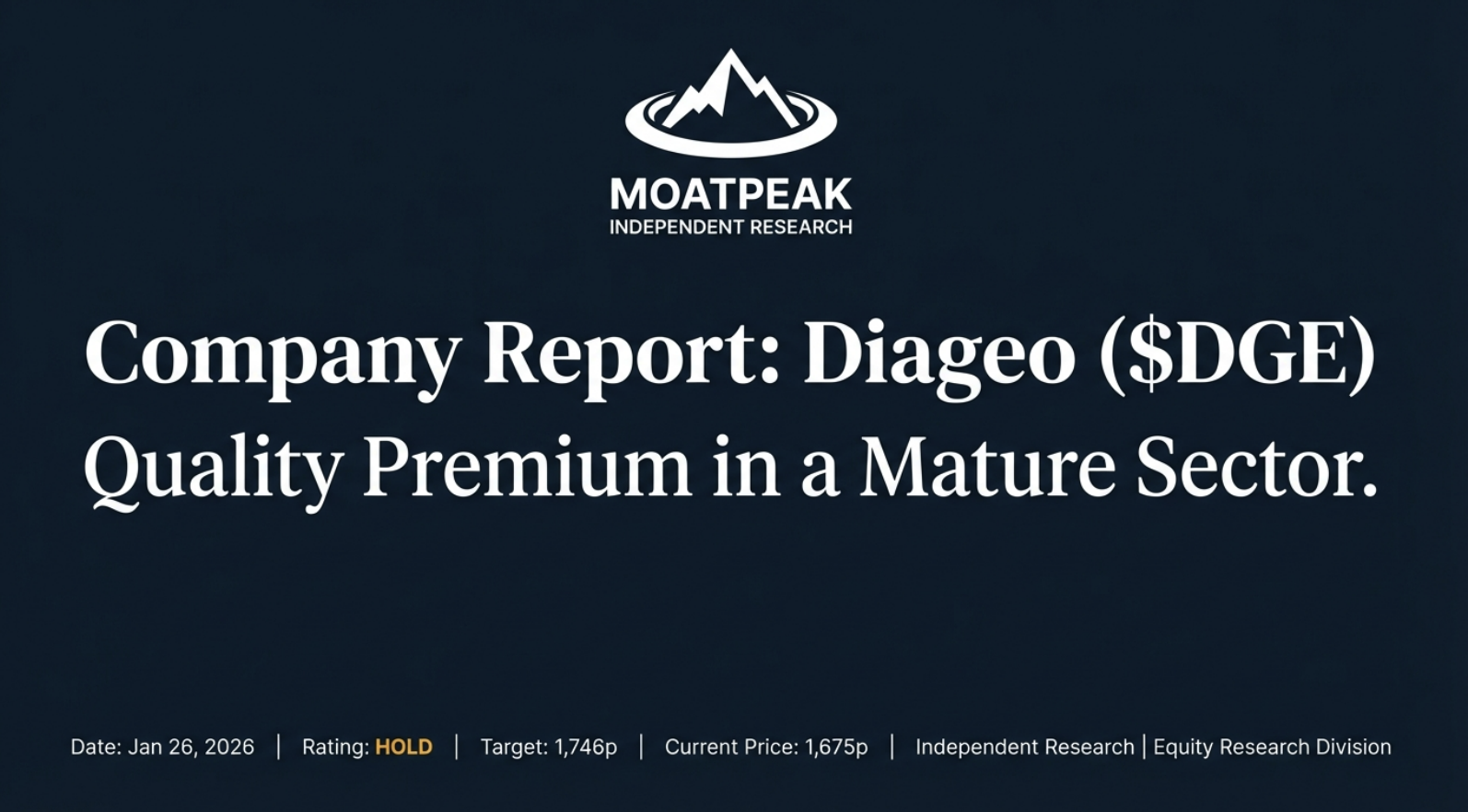
This is what a MoatPeak report looks like.
Diageo ($DGE): Quality Premium in a Mature Sector
Diageo is a global spirits quasi-monopoly trading at 1,675p — just 4.2% below its blended fair value of 1,746p. With a 32.8% EBITDA margin and 4.5% dividend yield, it suits income investors, but 3.3x net leverage and stagnant -0.1% revenue growth make it a 'fair price for a fair business' rather than a compelling opportunity.
HIGHLIGHTS
• Current price of 1,675p sits just 4.2% below blended fair value of 1,746p — with only +4.2% upside in the base case, risk/reward is asymmetric to the downside given the bear case implies 1,054p (-37%).
• FY25 revenue of $20.2B is essentially flat at -0.1% YoY — the volume problem is structural, driven by younger generations drinking less and growth depending entirely on price/mix rather than volume expansion.
• EBITDA margin of 32.8% ($6.6B) and free cash flow of $2.7B (13.6% margin) demonstrate exceptional operational profitability, with a quality scorecard of 6.7/10 reflecting the tension between high profitability and stagnant top-line.
• Net Debt/EBITDA of 3.3x is the defining constraint — above the 2.5x re-rating threshold and limiting strategic agility; deleveraging to 2.5x is a prerequisite for a multiple expansion and any meaningful shareholder returns acceleration.
• Dividend yield of approximately 4.5% is the primary investment case — a safe, growing income stream from a portfolio of irreplaceable global brands (Johnnie Walker, Guinness, Tanqueray, Smirnoff) across 180+ markets.
• DCF base case implies 2,114p (+26%) but only at a 7.33% WACC with 2.2% terminal growth — small changes in regulation or WACC create massive valuation swings, as the sensitivity table spans 1,020p to 3,950p.
• Regulatory and tax risk is the highest-probability/highest-impact threat — EU/UK excise duty escalation targets spirits revenues, and the bear case scenario shows margin compression to 31% driving the stock to 1,054p (-37%).
• Bull case at 3,603p (+115%) requires premiumization and deleveraging acceleration — a decade-long value creation story that income-oriented investors should acknowledge but not underwrite at full multiple.
• Rating: HOLD — accumulate between 1,400p–1,500p where the entry price compensates for leverage risk and regulatory headwinds; current price is fair but not a bargain for new investors.
EXECUTIVE SUMMARY
Diageo is the world's largest premium spirits company by revenue — a quasi-monopoly portfolio of irreplaceable brands including Johnnie Walker, Guinness, Tanqueray, Smirnoff, and Bulleit, distributed across 180+ markets with entrenched retail and on-premise relationships. The investment thesis is not a growth story but a stability and income story: Diageo generates $2.7B in annual free cash flow, sustains a 32.8% EBITDA margin, and offers a ~4.5% dividend yield that is well-covered by cash generation. The complication is that stagnant revenue (-0.1% YoY), 3.3x net leverage, and a structural headwind from declining drinking rates among younger demographics create a business at equilibrium rather than in ascent — 'a fair price for a fair business' with a bear case that is genuinely painful at -37% downside.
The financial profile rewards income investors and penalizes growth investors. FY25 revenue of $20.2B generates EBITDA of $6.6B (32.8% margin) and FCF of $2.7B, but the top-line stagnation is the report's central concern. Volume is declining as younger consumers reduce alcohol consumption, and the current growth dynamic depends entirely on price and mix — raising prices on premium brands to offset volume erosion. This pricing-over-volume model is sustainable for several years but is not a perpetual motion machine; at some point, price elasticity limits further extraction. The quality scorecard of 6.7/10 reflects exactly this tension: profitability scores 9/10 and moat width scores 8/10, but growth receives only 3/10 (volume stagnation) and financial health 5/10 (high leverage).
Three catalysts could move the thesis positively: premiumization success in emerging markets, deleveraging progress toward the 2.5x target, and US spirits market share recovery following category headwinds. The US market is a key watchpoint — premium spirits have faced inventory destocking across distributor channels, and a normalization of US spirits data would represent the single largest near-term positive catalyst. FY26 guidance in February 2026 is the first test: if management guides margin expansion to 33.5% and signals deleveraging acceleration, the multiple has room to expand toward the DCF base case of 2,114p. UK/EU excise tax decisions are the key negative catalyst to monitor within six months.
The risk profile is dominated by two high-probability threats. Regulatory and tax risk is the most impactful — EU and UK governments consistently treat spirits as a reliable tax revenue source, and excise duty escalation compresses both volume and margin simultaneously. This risk materializes gradually but compounds: a sustained 1-percentage-point margin decline from 32.8% to 31.8% triggers meaningful valuation deterioration given the DCF leverage to margin assumptions. The leverage risk is secondary but structural: at 3.3x Net Debt/EBITDA, Diageo has limited capacity for acquisitive growth, buybacks, or dividend acceleration, and any earnings miss widens the gap to the 2.5x re-rating threshold. The bear case at 1,054p represents a -37% drawdown scenario from current prices — disproportionately large relative to the +4.2% upside in the base case.
The positioning recommendation is HOLD with a clear accumulation entry point. At 1,675p, Diageo is fairly valued — not cheap enough to be compelling for value-oriented buyers, not overvalued enough to warrant a sell. The optimal action for income-focused investors is to accumulate between 1,400p–1,500p, where the dividend yield approaches 5% and the downside to the bear case is partially compensated. For growth-oriented investors, Diageo does not offer a compelling return profile — 2–3% organic growth capped by volume headwinds will not compound capital at the rates required to compete with higher-growth alternatives. The brand portfolio is genuinely irreplaceable; the business model generates reliable cash; the question is simply whether the current price adequately compensates for the structural headwinds.


Vilnius, V. Nagevičiaus g. 3, LT-08237, Lithuania
Company code: 307596762