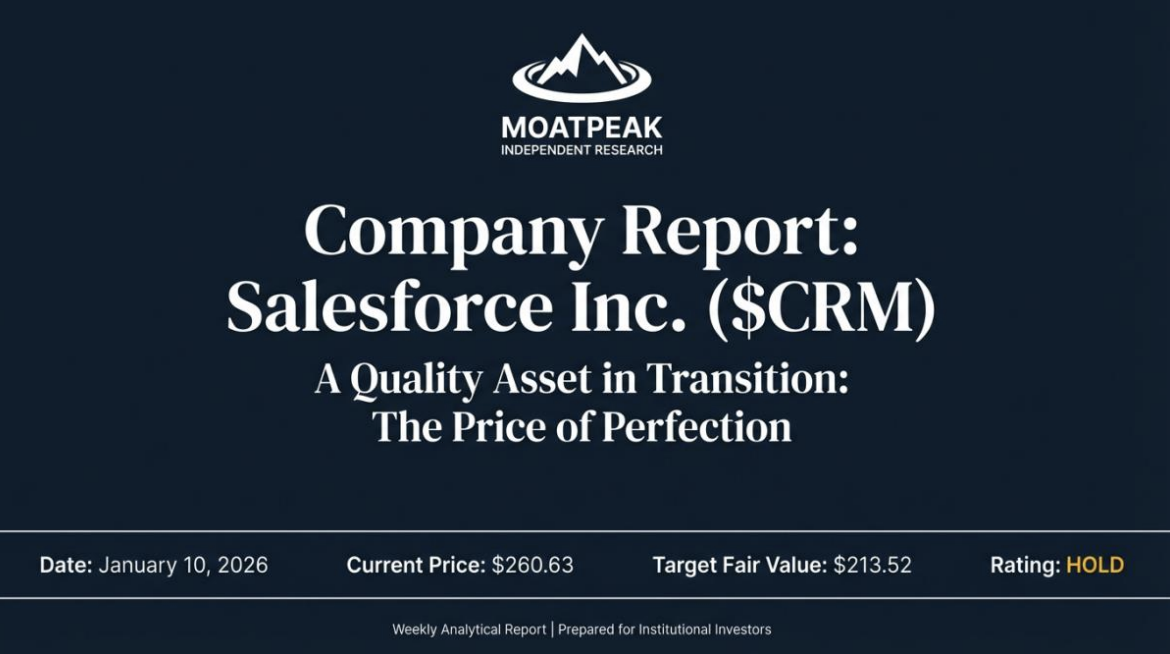
This is what a MoatPeak report looks like.
Salesforce Inc. ($CRM): A Quality Asset in Transition — The Price of Perfection
Salesforce trades at $260.63 against a fair value of $213.52 — a 22% premium for a business undergoing its most consequential strategic pivot in years. Agentforce AI revenue has reached $540M ARR (+330% YoY), but the valuation demands flawless execution before the margin of safety improves.
HIGHLIGHTS
• Agentforce AI platform — Salesforce's autonomous agent layer — has reached ~$540M ARR as of Q3 FY26, growing +330% YoY and converting over 50% of new AI bookings from existing clients.
• Revenue (TTM) stands at $41.3B (+8.6% YoY), with Salesforce controlling 22% of global CRM market share across 250,000+ enterprise organizations.
• Non-GAAP operating margin has expanded to 35.5% — up from ~18% in FY21 — driven by activist-pressure-induced cost discipline and adherence to the 'Rule of 40'.
• Free cash flow margin of 32% reflects the platform's capital-light model, with enterprise migration costs of $2–5M per client creating substantial switching cost moats.
• Valuation disconnect is stark — current price of $260.63 implies a 22.1% premium to the blended fair value of $213.52, with the bull case weighted fair value reaching only $213.80.
• The Microsoft competitive threat centers on pricing, not product — Dynamics 365 bundles Copilot at $0.50 per seat vs. Salesforce's consumption-based $2.00 per conversation AI pricing model.
• Bear case ($177, 20% probability) materializes if AI fails to scale beyond early adopters and Agentforce ARR stalls below the $2–3B target required to justify current multiples by FY2027.
• Moat rating of 8.8/10 reflects 1M+ AppExchange ecosystem partners and a data network effect — once enterprise data is in the Salesforce Data Cloud, migration costs become prohibitive.
• Rating: HOLD — quality is undeniable, but entry zone begins at $240–245; new investors face asymmetric downside at current prices with no margin of safety.
EXECUTIVE SUMMARY
Salesforce has evolved from a CRM application into the operating system for enterprise customer relationships — a platform housing Sales Cloud, Service Cloud, Marketing Cloud, Commerce Cloud, and MuleSoft/Tableau/Slack under a unified Data Cloud architecture. The investment thesis rests on three pillars: the Agentforce AI pivot transforming the product from assistive copilot to autonomous agent, an 8.8/10 moat rating underpinned by $2–5M per-enterprise migration costs and 1M+ AppExchange partners, and operational discipline that has lifted non-GAAP margins from 18% in FY21 to 35.5% today. At $260.63, investors are being asked to pay a 22.1% premium to intrinsic value — a price that leaves no room for the execution risk embedded in this transformation.
With TTM revenue of $41.3B growing at 8.6% year-over-year and 22% global CRM market share across 250,000+ organizations, Salesforce's financial engine is undeniably powerful. Non-GAAP operating margin of 35.5% and a 32% free cash flow margin demonstrate the scalability of the cloud model, while the Data Cloud unified architecture creates a defensible data gravity effect that compounds with each new client integration. The quality scorecard of 8.2/10 reflects best-in-class profitability, though the valuation dimension scores lower — the stock is priced for a scenario where Agentforce reaches $2–3B in ARR by FY2027, a target that requires sustaining the current 330% growth trajectory well into a market where enterprise AI budgets remain in early-stage allocation.
The central growth catalyst is the transition from Einstein GPT's assistive copilot model to Agentforce's autonomous end-to-end workflow execution. At ~$540M ARR and a consumption-based pricing model of approximately $2.00 per conversation, the monetization architecture is structurally superior to bundled competitors — incremental AI usage generates incremental revenue rather than diluting existing seat license economics. If Agentforce ARR reaches $2–3B as targeted, operating leverage at the current margin structure implies material upside to consensus earnings estimates. The secondary catalyst is enterprise cross-sell: over 50% of new AI bookings originate from existing clients, demonstrating that Salesforce's installed base is the distribution channel for AI monetization, not a separate market-development cost.
The primary risk is not product obsolescence but pricing commoditization. Microsoft Dynamics 365 bundles Copilot into existing O365 seat licenses, creating a 'good enough' alternative that 48% of CIOs view as a priority integration point due to ease of deployment. If AI functionality becomes a table-stakes bundled feature rather than a premium standalone product, Salesforce's $2.00 per conversation pricing model faces structural pressure. A secondary risk is concentration — Agentforce's early adoption is skewed toward large enterprise clients with complex workflows, while the SMB market may default to cheaper Microsoft alternatives. The bear case at $177 (20% probability) reflects a scenario where AI monetization plateaus at current ARR levels, growth decelerates to 7–8%, and the market re-rates the multiple toward traditional SaaS peers.
From a positioning standpoint, Salesforce is a HOLD at $260.63 — not a sell, because the business quality is genuinely exceptional, but not a buy, because the valuation discounts successful execution of a multi-year transformation with no cushion for setbacks. The weighted average fair value of $213.80 reflects the probability-adjusted outcome of all scenarios, and the entry zone for long-term investors begins at $240–245. Investors already holding the position should maintain exposure — the FCF generation and structural moat make it a core compounder — but new capital should wait for a re-entry point that restores the margin of safety this quality of business deserves.


Vilnius, V. Nagevičiaus g. 3, LT-08237, Lithuania
Company code: 307596762